Core Fear
Becoming right after no one thinks they need him anymore.
He spent forty years learning what a sentence was trying to hide.
Clint Burnett is a veteran editor, literary bridge, field listener, craft guardian, and reluctant adapter. He knows how to speak to authors, publishers, bookstore owners, technologists, and librarians because his work has always been translation.
He once bridged author to reader, author to publishing house, manuscript to market. Now the bridge has changed shape. Clint has to decide whether the change means he is obsolete — or whether his work has finally found another form.

A vertical introduction to Clint’s world: marked-up pages, coffee rings, old publishing corridors, bookstore back rooms, conference badges, track changes, and a man realizing the sentence may still need him in a world he no longer recognizes.
Becoming right after no one thinks they need him anymore.
Editing is not cleanup. It is judgment, translation, listening, structure, and responsibility.
False polish, author fear, reader promise, market pressure, bookstore signals, technology gaps, and the sentence underneath the sentence.
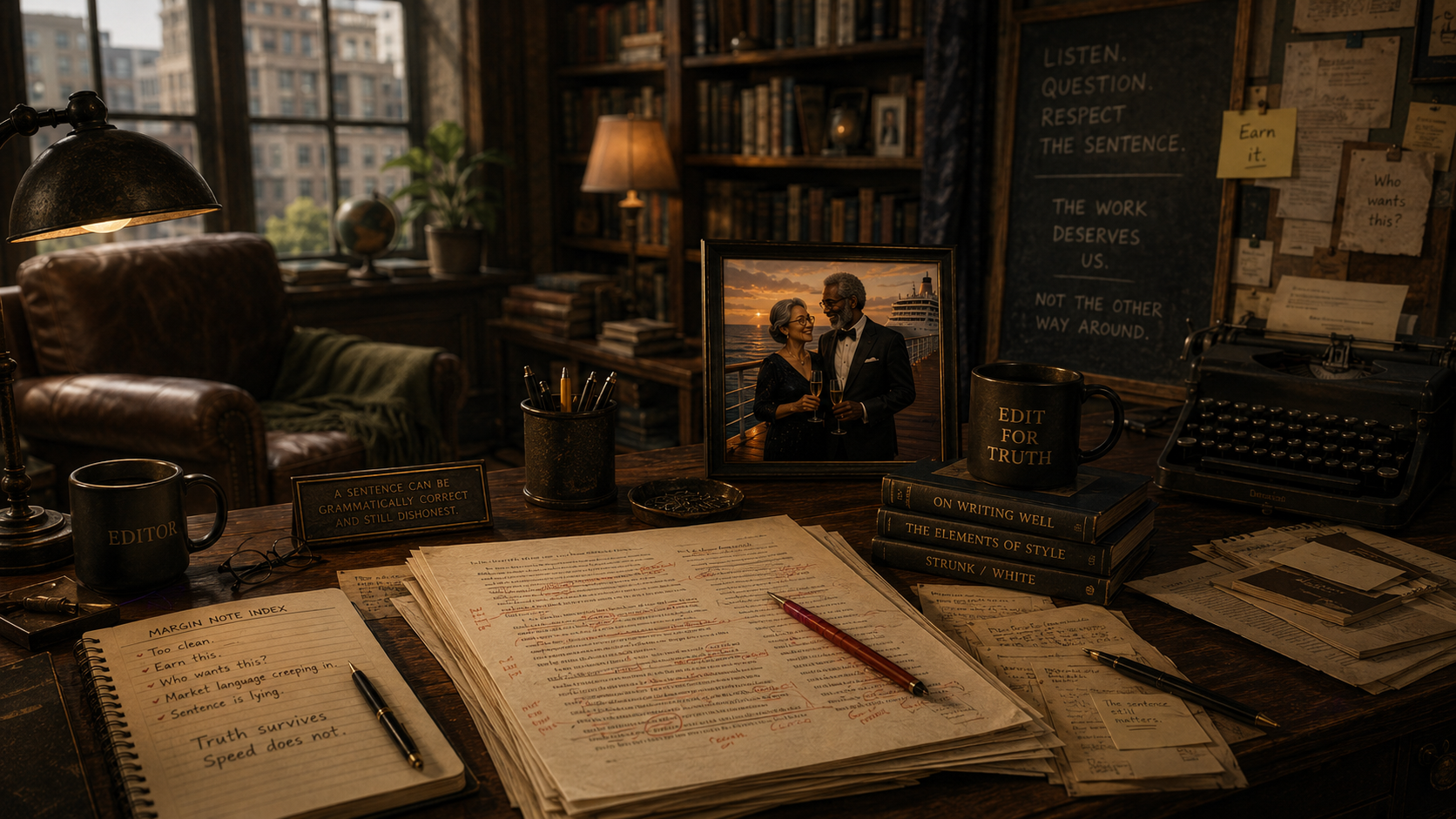
“The sentence was grammatically fine. That was not the same thing as good.”Editorial Fragment
“He was not finished. His work had only changed rooms.”Bridge Fragment
“The sentence still mattered.”Final Fragment
| Editorial Note | Surface Meaning | Deeper Meaning |
|---|---|---|
| Too clean. | The prose is polished. | The author is hiding. |
| Earn this. | The scene is underdeveloped. | The emotion is unearned. |
| Who wants this? | Motivation unclear. | The character has no engine. |
| Market language creeping in. | The voice has shifted. | The author is performing success. |
| Sentence is lying. | Technically correct. | Emotionally false. |
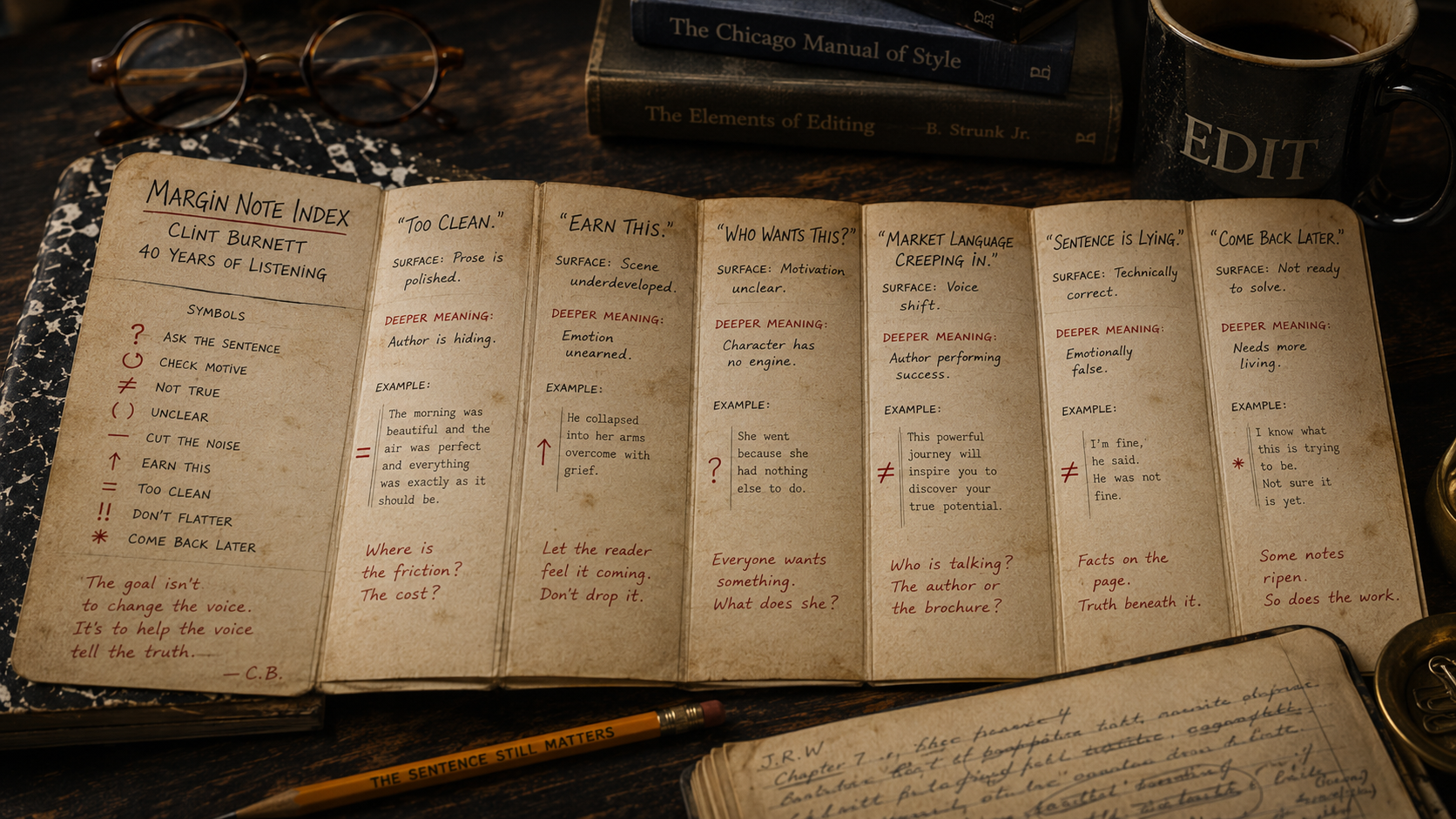
The mark that says the work deserves more than speed.
Author to reader. Store to system. Past to future.
The quiet data that only appears when people trust you enough to talk.
The old skill entering a new room without surrendering itself.
Clint was expensive because he knew what people were actually buying: not punctuation, not polish, not a faster route to publication.
They were buying judgment earned slowly. They were buying the ability to hear what the author wanted the book to become, what the publisher needed it to survive, and what the reader needed to find once the book entered the world.
| Service | What People Think It Is | What Clint Knows It Is |
|---|---|---|
| Line edit | Grammar / style | Rhythm, pressure, truth. |
| Developmental edit | Plot notes | Architecture and consequence. |
| Author consultation | Advice call | Intervention before collapse. |
| Revision plan | Checklist | Map back to meaning. |
| Author Says | Clint Hears | Actual Issue |
|---|---|---|
| “I already used AI.” | Then why are you here? | Polish without diagnosis. |
| “Can you just clean it up?” | Do not ask me to care. | Manuscript needs structure. |
| “Editors charge too much.” | Expertise as inconvenience. | Budget / value mismatch. |
| “AI said it was strong.” | Machine reassurance. | Author wants permission. |
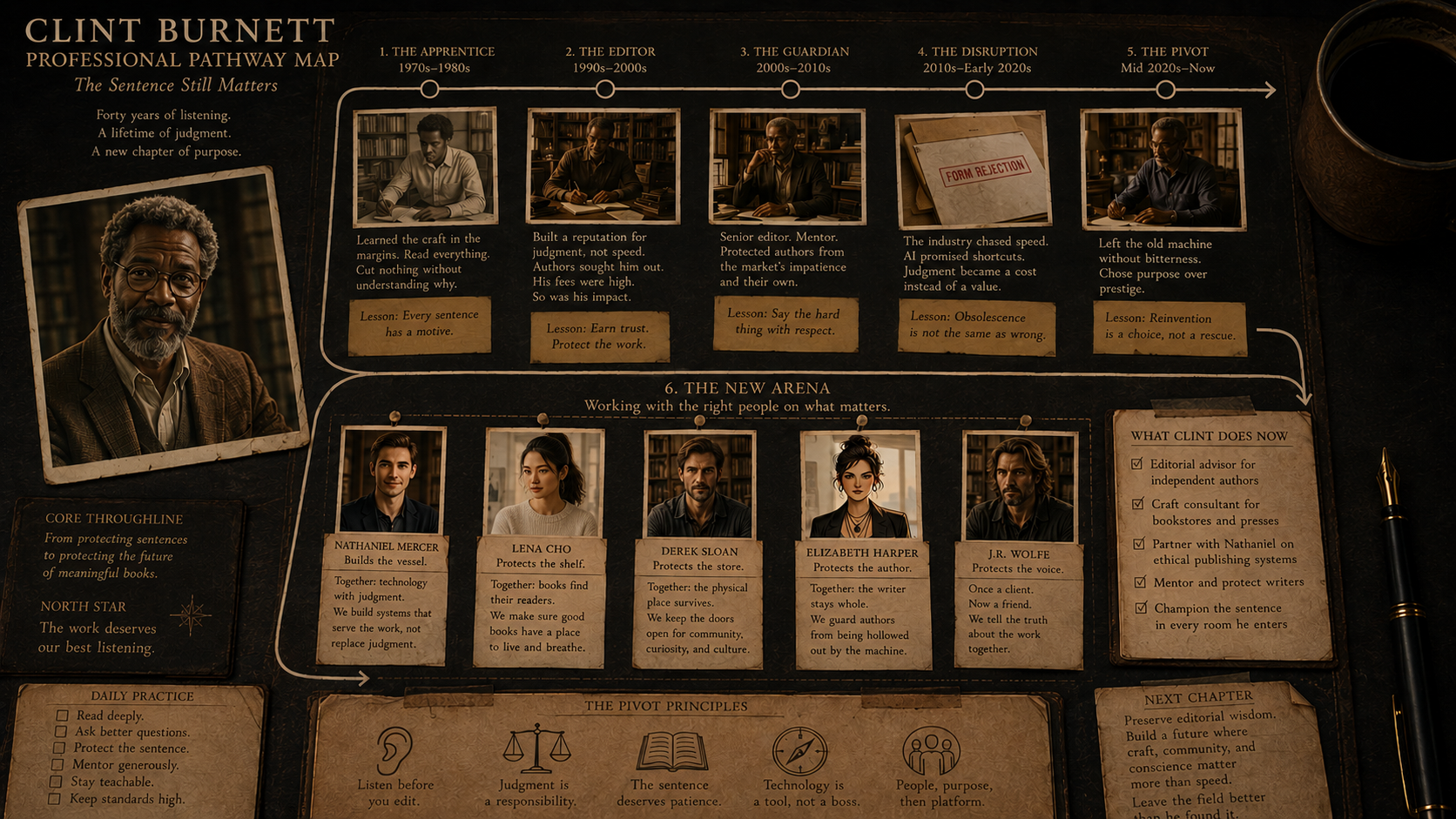
Clint knows what a strong author sounds like before the market starts sanding down the edges.
He has seen talent become brand. He has seen sentences learn to behave. He has seen writers slowly become easier to sell and harder to recognize.
| Stage | What Changed | What Clint Noticed |
|---|---|---|
| Early J.R. | Riskier voice | Pages had voltage. |
| Breakout J.R. | Cleaner structure | Ambition still intact. |
| Brand J.R. | Predictable rhythm | Safety entering syntax. |
| Later J.R. | Fatigue | Sentence asking to come home. |
| Store Signal | What Owner Said | Clint’s Read |
|---|---|---|
| Chain interest rising | “They call it partnership.” | Acquisition pressure. |
| Local author shelves shrinking | “No space anymore.” | Risk moved downward. |
| Event attendance uneven | “Readers still come, but differently.” | Community not dead. |
| Vendor terms worsening | “Numbers stopped working.” | Pressure coordinated. |
| Staff exhausted | “We love this place.” | Love without structure failing. |
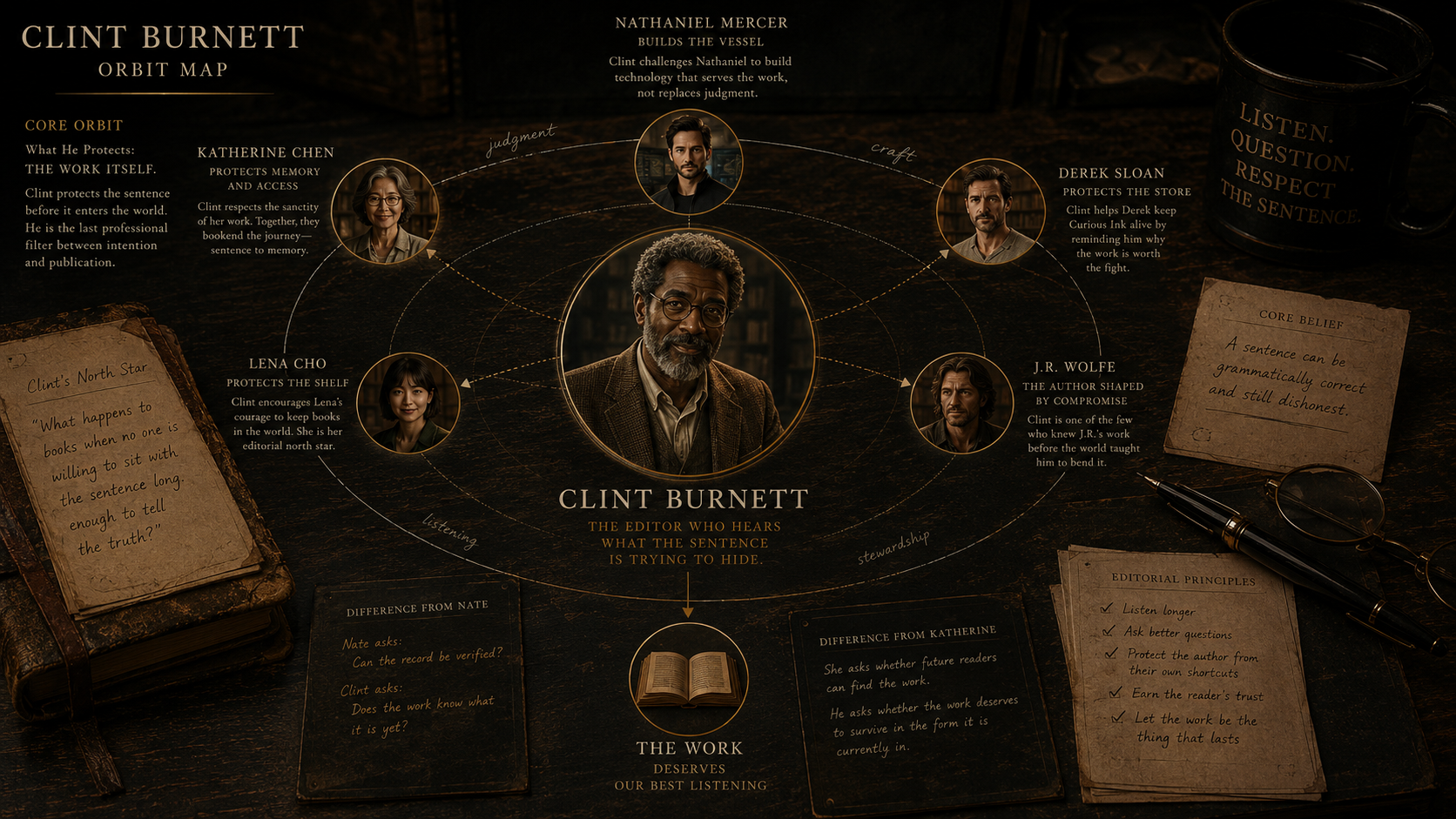
Derek is Clint’s closest friend inside the Margins Abound orbit. Their friendship is dry, practical, loyal, and allergic to performance.
Derek hears Clint’s fatigue. Clint hears Derek’s panic. Both understand the work nobody sees until it fails.
| Moment | Derek Says | Clint Hears |
|---|---|---|
| Store pressure | “We’re fine.” | No, they are not. |
| Retirement talk | “You’d hate golf.” | Please do not disappear. |
| Lena’s overextension | “She won’t stop.” | Neither would you. |
| Nate’s arrival | “Tech people make me itch.” | Same, but listen. |
Clint distrusts the world Nathaniel represents before he trusts Nathaniel. He has seen what efficiency does when it enters publishing without respect for craft.
But Nathaniel listens. That changes the equation.
Clint begins to understand that adaptation does not require surrender. His knowledge may not need a funeral. It may need a vessel.
| Nathaniel Says | Clint First Hears | Clint Later Understands |
|---|---|---|
| Database | Flattening | Memory vessel. |
| Schema | Jargon | Structure for judgment. |
| Input field | Reduction | Place for context. |
| Verification layer | Delay | Editorial patience in system form. |
| Human review | Maybe he understands. | Maybe this can work. |
Katherine does not make Clint feel young. That would be too small.
She makes him feel not finished.
She recognizes his value at the exact moment he is beginning to mistake exhaustion for obsolescence. He protects the sentence. She protects the path to the sentence.
| Subject | Clint | Katherine |
|---|---|---|
| AI editing | “It cannot hear the sentence.” | “It also cannot preserve context.” |
| Libraries | “Last place readers still ask humans.” | “And the first place they should.” |
| Retirement | “Maybe I’m done.” | “Maybe your work needs a new shelf.” |
| Romance novels | “You read those?” | “I preserve emotional history.” |
Before, Clint bridged author to reader, author to publisher, manuscript to market. Now the bridge includes independent bookstores, ethical databases, content creators, librarians, new authors, old authors, and systems still learning whether they deserve trust.
The publishing world is changing. Clint’s value is not disappearing. It is moving.
Clint’s role is not nostalgia. He holds the judgment layer between what a manuscript says, what a system records, what a bookstore notices, and what a reader may eventually receive.
His danger is bitterness. His usefulness is precision. His next life begins when he agrees to translate himself.
Defining value only by the industry that once paid him well. Treating every new tool as proof of cultural collapse. Assuming retirement is dignity when it may actually be retreat.
That publishing houses were pure guardians of quality. That all self-published authors are careless. That being right is enough. That expertise survives without being transferred.
That the sentence may still need him in a world he does not recognize. That Nathaniel may be building something he cannot dismiss. That Katherine sees his bitterness as clearly as his brilliance. That obsolescence can become self-fulfilling if he refuses to translate himself.
A cinematic editorial archive fragment with manuscript close-ups, bookstore field notes, Clint and Nathaniel whiteboard scenes, and craft adapting without surrender.

A recovered fragment for readers entering Clint Burnett’s archive of craft, judgment, and adaptation.
Clint understands that speed can polish a sentence without making it honest. He understands that systems can process books without truly hearing them.
This character novella follows craft, judgment, friendship, late-life recognition, and the editor who refused to let speed replace discernment.
Watch the novella promo, then receive the character gift and continue into Clint’s archive: margin notes, editorial ledgers, author objection files, bookstore field notes, technology translation sheets, Katherine fragments, and the bridge architecture behind his place in The Rating Game.
For readers who know the sentence can be technically correct and still emotionally false.
