Core Fear
Building something useful that later becomes a tool for the same extraction he opposed.
The human factor was not the flaw in the system. It was the only reason the system could be trusted.
Nathaniel Mercer is not anti-technology. He is anti-extraction.
A systems architect from Silicon Valley, Nathaniel understands databases, scale, automation, and information pipelines. What makes him dangerous is that he also understands ethics, consent, verification, and the cost of building systems that treat people like inventory.

A vertical introduction to Nathaniel’s world: transparent interfaces, whiteboard ethics diagrams, bookstore intake cards beside database schemas, green terminal glow, and a technologist trying to build systems that refuse to become extraction engines.
Building something useful that later becomes a tool for the same extraction he opposed.
A database is only as clean as the ethics of its intake.
Consent layers, weak assumptions, ownership structures, human verification paths, and the places where speed begins replacing care.

“That’s not innovation. That’s extraction with a pitch deck.”Systems Fragment
“The vessel would be slower. That was the point.”Architecture Fragment
“Human judgment is not inefficiency.”Verification Fragment
| Source | Verification | Harm Risk | Decision |
|---|---|---|---|
| Public review scrape | Weak | Manipulation risk | Refuse |
| Bookstore intake card | Human-confirmed | Low | Use carefully |
| Author-submitted metadata | Cross-check required | Moderate | Verify |
| Reader behavior tracking | Passive collection | High | Reject |
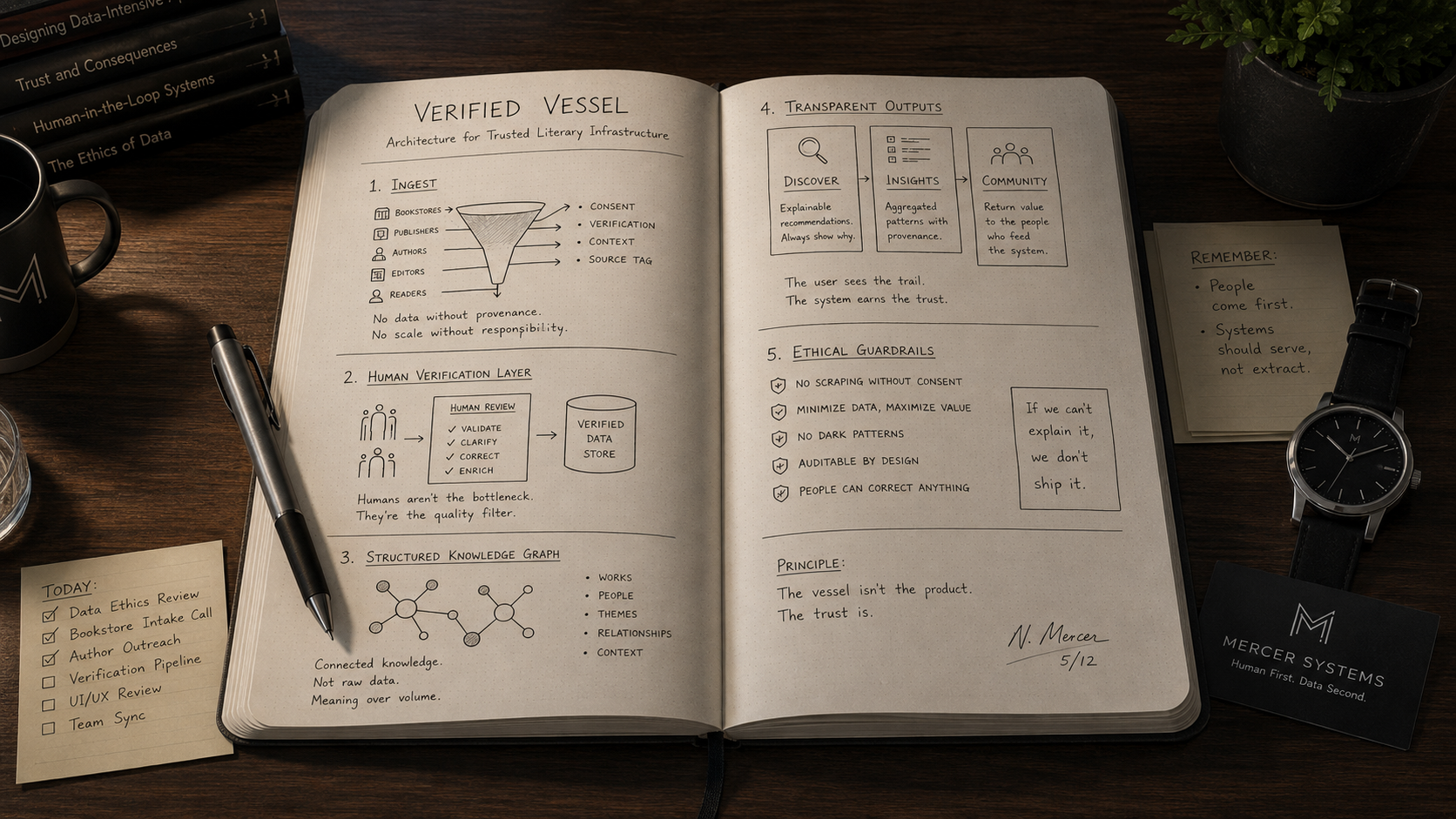
Nathaniel Mercer believes systems can help people breathe again. But only if the systems remain accountable to the humans feeding them.
The vessel is not magic. The vessel is structure: verified input, human context, correction paths, bookstore signals, editor judgment, and relationships that can still be audited by people instead of hidden behind corporate opacity.
| Function | Tech Can Do | Humans Must Do |
|---|---|---|
| Store metadata | Organize fields | Confirm meaning |
| Reader matching | Surface patterns | Understand feeling |
| Bookstore networks | Route requests | Maintain trust |
| Overlooked book tracking | Preserve records | Determine significance |
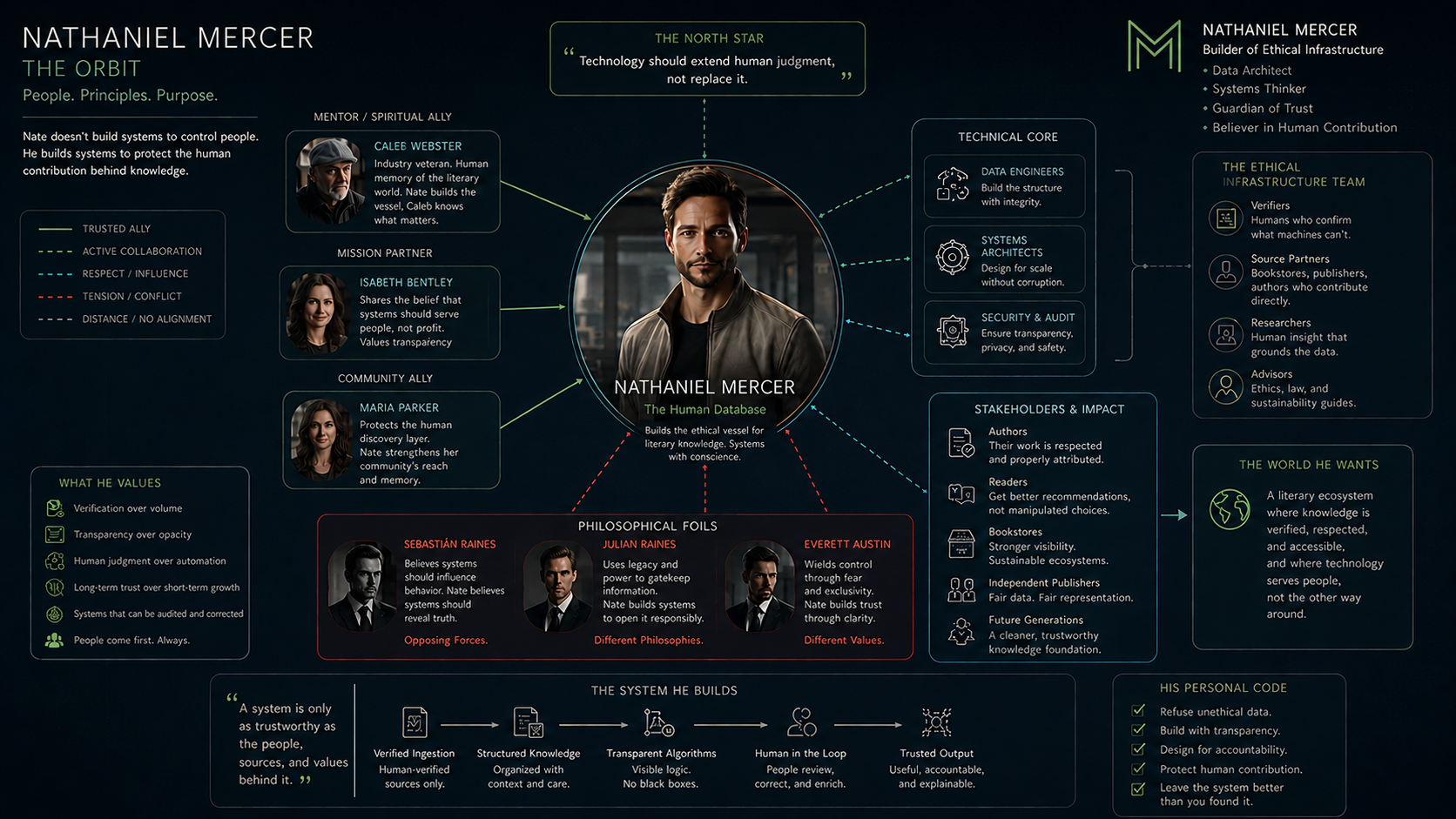
Clint Burnett becomes the person who teaches Nathaniel the limits of clean data.
Clint is slow. Precise. Human. Decades deep in editorial intuition.
Nathaniel realizes Clint is not unscalable because he is outdated. He is unscalable because judgment itself requires accountability.
| Clint Says | Nathaniel First Hears | Nathaniel Later Understands |
|---|---|---|
| “The sentence is lying.” | Editorial mysticism | Tone and intent mismatch |
| “The market isn’t the reader.” | Anti-data sentiment | Buying behavior ≠ emotional attachment |
| “You can’t automate taste.” | Resistance | Taste requires accountable judgment |
| “Slow down.” | Inefficiency | Verification layer |
Nathaniel sees Elizabeth Harper at her worst and does not turn away.
Not because he pities her. Because he recognizes grit when he sees it.
Elizabeth makes mistakes. Panics. Reaches too fast sometimes. Regrets it. Rebuilds anyway.
Nathaniel respects that more than polish.
| Moment | Surface Read | Deeper Signal |
|---|---|---|
| Elizabeth admits mistake | Instability | Honesty under pressure |
| Rejects easy rescue | Irrational | Boundary forming |
| Starts over publicly | Reputational risk | Grit |
| Protects someone else | Impractical | Moral structure |
Nathaniel enters the bookstore world through Clint. What he discovers there changes the architecture of everything he builds afterward.
Lena’s shelf intuition is data. Derek’s inventory warnings are data. Reader hesitation is data. Handwritten recommendation cards are data.
The question is not whether the information matters. The question is whether technology can preserve the human meaning instead of stripping it away.
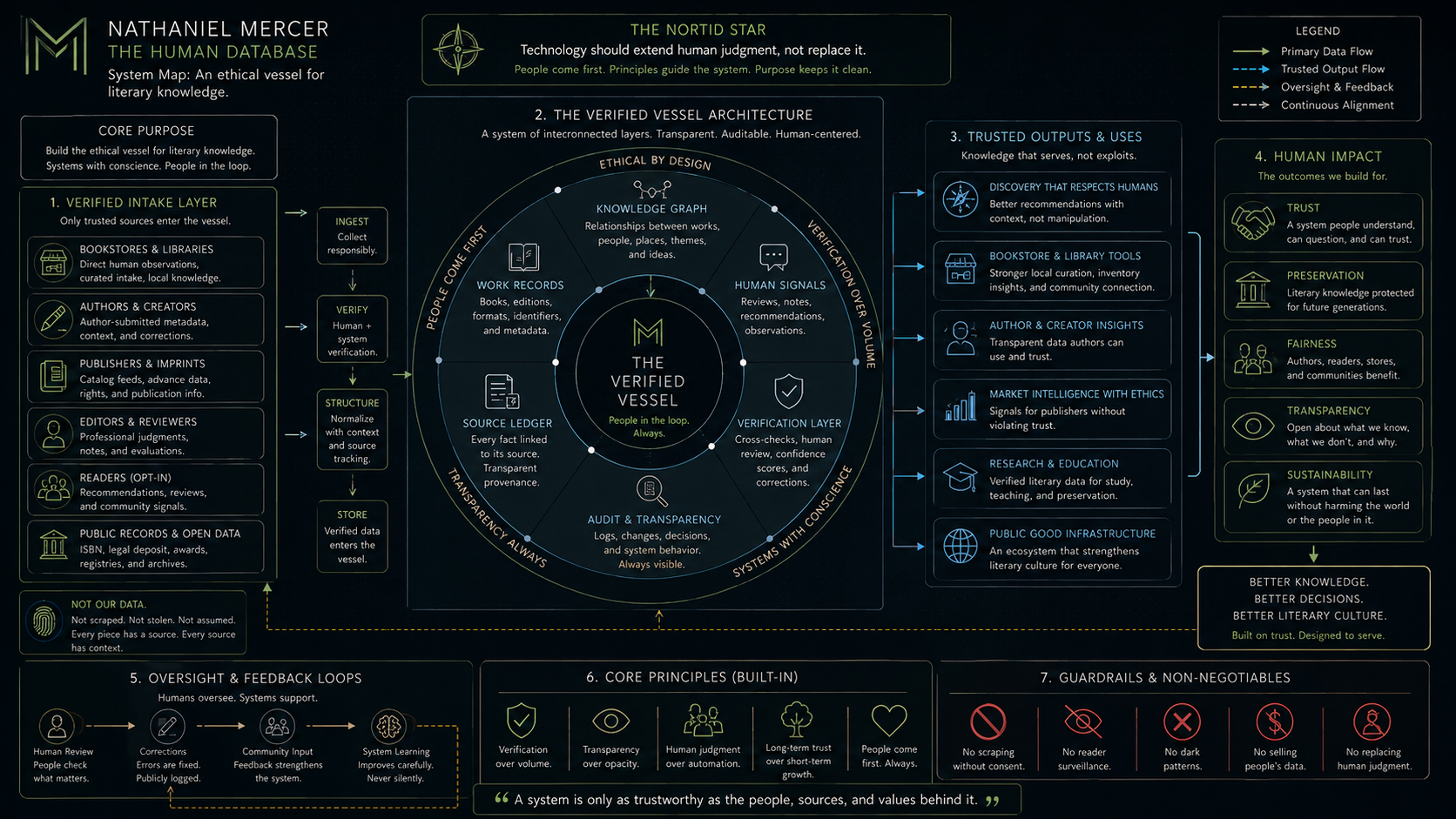
| Layer | Question | Pass / Fail |
|---|---|---|
| Consent | Did the source agree? | Unclear = hold |
| Verification | Can another human confirm? | No = uncertain |
| Bias | Who benefits from this? | Hidden incentives = flag |
| Harm | Could this unfairly damage people? | Yes = review |
| Ownership | Can users leave with their data? | No export = fail |
Believing ethics can be added after scale. Assuming transparency is a feature instead of a foundation. Treating distrust as irrational when sometimes distrust is the immune system.
That cleaner data automatically creates better outcomes. That human review is too slow to matter. That useful systems are automatically good systems.
That the alternative to extraction may fail simply because it refuses to extract. That Clint’s knowledge could disappear faster than Nathaniel can preserve it. That human networks could be swallowed by systems built without conscience.
A cinematic interface sequence, bookstore signal map, terminal visual, whiteboard ethics architecture, and human annotation layer about trust versus scale.
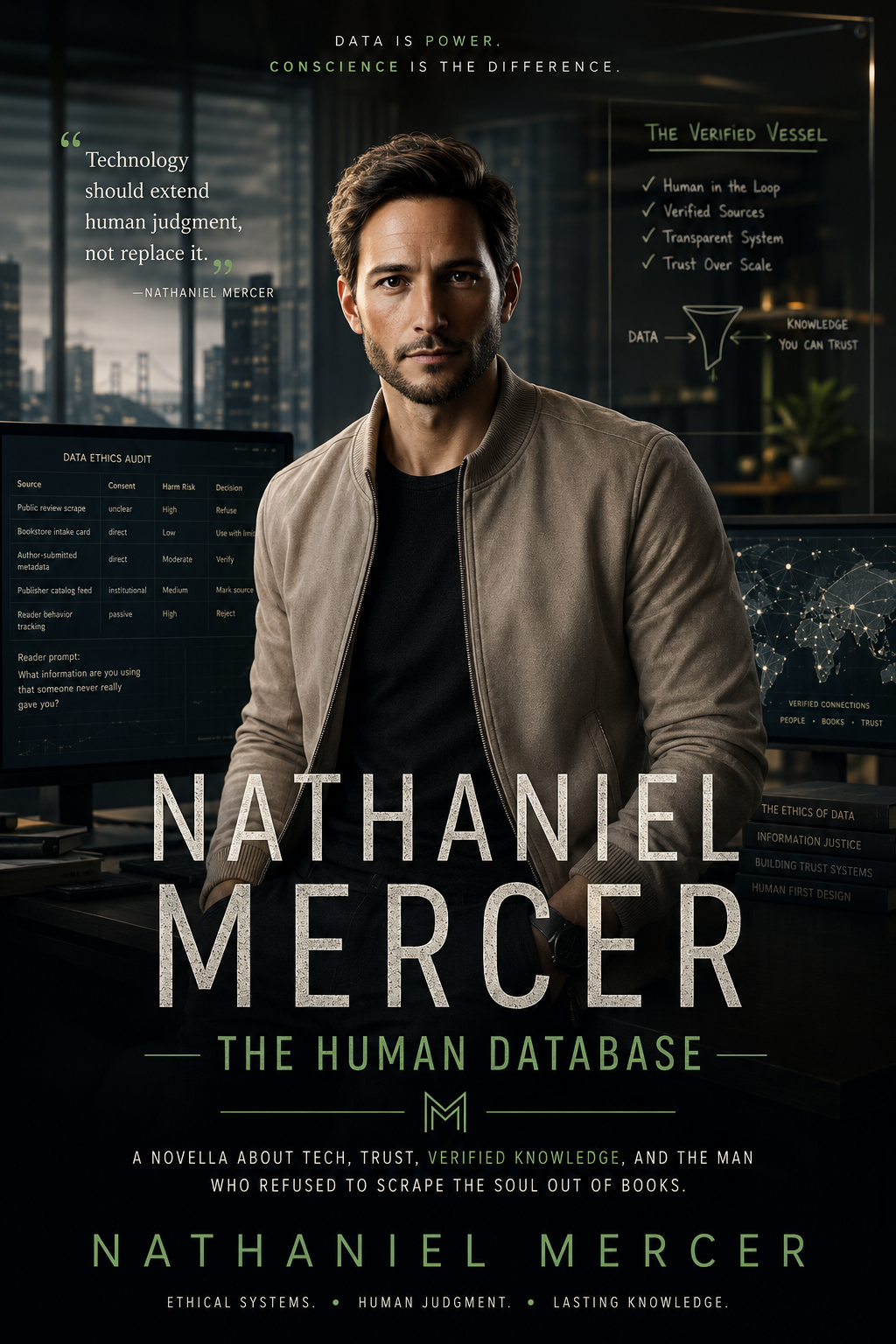
A recovered fragment for readers entering Nathaniel Mercer’s architecture of trust.
Nathaniel Mercer knows the danger is not the database. The danger is what people decide they are allowed to take before the database is built.
This character novella follows ethical systems, verified knowledge, human judgment, consent, scale, and the technologist who refused to scrape the soul out of books.
Watch the novella promo, then receive the character gift and continue into Nathaniel’s hidden infrastructure: the audits, the friction layers, the human signals, and the system that had to stay slow enough to deserve trust.
For readers who want to step past the interface and into the ethics beneath it.
