Core Fear
Becoming permanently useful but never central.
He knew enough to hesitate, but not enough to leave.
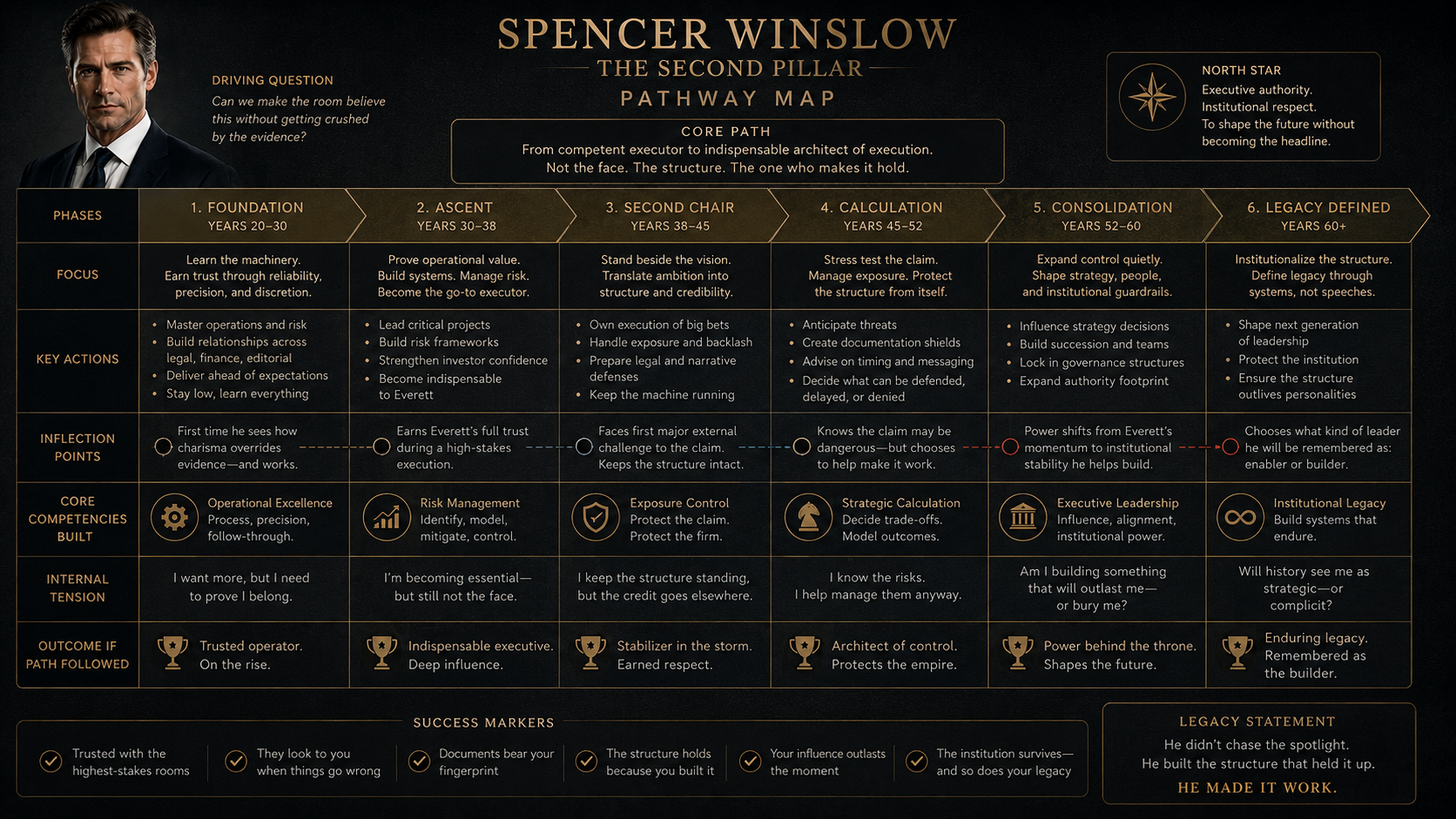
Spencer Winslow is not Everett Austin’s shadow. He is the executive structure beside the spectacle: measured, procedural, ambitious, risk-aware, and quietly resentful of being treated as support when the machinery depends on him.
Everett moves the room. Spencer makes sure the room has paperwork afterward.

A vertical introduction to Spencer’s world: glass walls, annotated contracts, blue-gray dashboards, family-tree diagrams, controlled lighting, and a man who understands that the dangerous claim is not complete until someone makes it operational.
Becoming permanently useful but never central.
A claim does not become power until it has systems, paperwork, timing, and enforceable structure behind it.
Liability, document gaps, board reactions, legal phrasing, Everett’s overreach, Julian’s calm, and who asks the second question.

“Everett made the claim. Spencer made it usable.”Operational Fragment
“Risk management is not morality.”Compliance Fragment
“The record would remember Spencer.”Fracture Fragment
| Room | Everett’s Role | Spencer’s Role |
|---|---|---|
| Investor meeting | Vision | Feasibility. |
| Press event | Headline | Credibility. |
| Legal strategy | Claim | Risk control. |
| Board call | Momentum | Execution. |
| Family gathering | Myth | Continuity. |
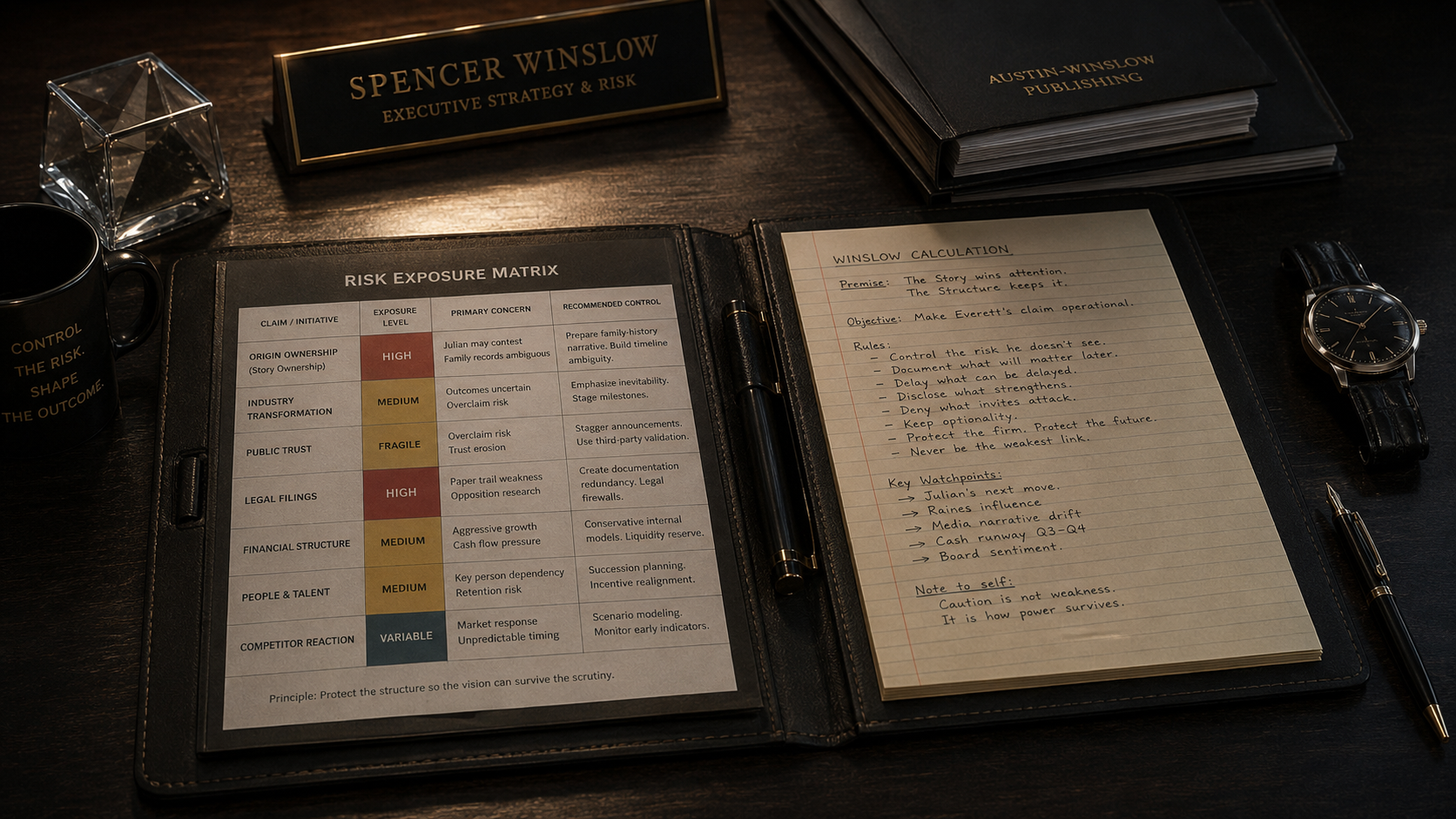
Every claim has a stress point. Spencer knows where to look.
The softer phrase hides the sharper force.
He does not need applause. He needs authority.
The thing omitted is often more dangerous than the thing said.
Spencer is not interested in spectacle for its own sake. Spectacle is unstable unless someone models the consequences.
He sees what can be defended, what can be denied, what can be delayed, what can be papered over, and what requires Everett to stop talking.
| Claim | Exposure Level | Recommended Control |
|---|---|---|
| Origin ownership | High | Prepare family-history ambiguity. |
| Industry transformation | Medium | Emphasize inevitability. |
| Public trust | Fragile | Stagger announcements. |
| Legal filings | High | Create procedural confidence. |
| Everett statements | Variable | Pre-approved language. |
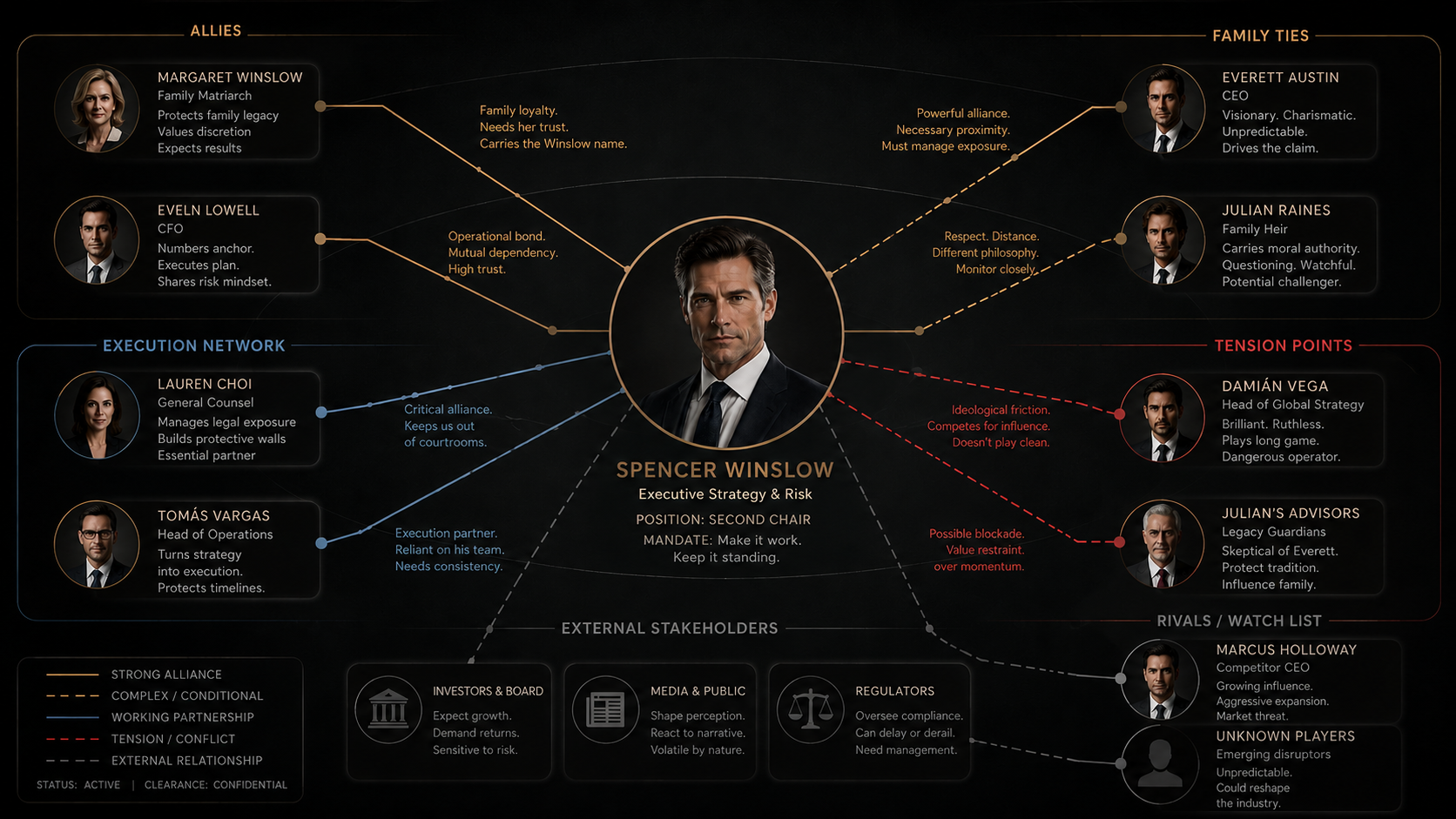
| Everett Provides | Spencer Provides | Hidden Cost |
|---|---|---|
| Charisma | Structure | Spencer becomes second face. |
| Audacity | Caution | Caution ignored when inconvenient. |
| Narrative | Execution | Plan becomes complicity. |
| Investor appetite | Risk control | Risk grows under polish. |
| Public certainty | Private doubt | Resentment accumulates. |
Spencer understands that power often becomes acceptable through vocabulary. The phrase has to sound reasonable before the structure can become enforceable.
He does not need the language to be beautiful. He needs it to survive review.
| Dangerous Phrase | Safer Phrase | Reason |
|---|---|---|
| We created it. | We advanced the framework. | Reduces origin challenge. |
| Collapse. | Transition point. | Preserves confidence. |
| Ownership. | Stewardship. | Softens aggression. |
| Control. | Alignment. | Reduces public alarm. |
| Acquisition. | Partnership. | Reduces resistance. |
| Branch Story | Public Value | Spencer’s Private Read |
|---|---|---|
| Raines integrity | Moral authority | Inconvenient advantage. |
| Austin ambition | Expansion | Necessary realism. |
| Winslow money | Stability | Never respected enough. |
| Publishing dynasty | Legitimacy | Must be controlled before others define it. |
| Julian’s restraint | Dignity | Maddening optics. |
Julian bothers Everett emotionally. Julian bothers Spencer strategically.
Spencer can prepare against ambition. He can prepare against attack. He struggles to prepare against quiet credibility.
| Julian Trait | Why It Is Dangerous | Proposed Response |
|---|---|---|
| Restraint | Makes him look principled. | Frame as indecision. |
| Family legitimacy | Origin advantage. | Complicate history. |
| Author status | Public sympathy. | Shift debate to business. |
| Lack of visible hunger | Hard to discredit. | Imply privilege. |
| Trusted silence | Creates suspense. | Force response. |
Spencer’s danger is not loudness. His danger is usefulness.
Everett supplies the weather. Spencer reads the barometer. Julian unsettles the room without trying. Sebastián understands pressure. Spencer understands what can survive the file.
Spencer is not merely adjacent to power. He is one of the mechanisms through which power becomes actionable. That makes him harder to dismiss and harder to absolve.
Treating caution as innocence. Letting Everett make the claim while Spencer makes it executable. Believing second chair means reduced responsibility.
That confidence can outrun every fact. That legal language can permanently soften force. That usefulness guarantees respect.
That he may be remembered only as an enabler. That his caution helped the claim survive longer than it should have. That being second did not make him less responsible.
A cinematic executive archive fragment with legal folders, risk dashboards, reflected spotlight, boardroom silence, annotated family-tree overlays, and caution becoming complicity.

A recovered fragment for readers entering Spencer Winslow’s archive of ambition, caution, proximity, and executive power.
Spencer understands the cost of standing beside spectacle. He understands the claim may break. He keeps making it usable anyway.
This character novella follows ambition, risk, language control, family positioning, strategic resentment, and the danger of becoming load-bearing while pretending to remain second.
Watch the novella promo, then receive the character gift and continue into Spencer’s archive: second-chair status logs, risk exposure matrices, cousin operating agreements, family positioning memos, language control sheets, Julian risk briefs, reader-entry pages, and the executive architecture behind his place in The Rating Game.
For readers who know caution can become complicity when it keeps power functional.
